
What is Lipedema?
Affects Millions of Women
Estimated to affect approximately 11% of post-puberty women worldwide.
Hormonal & Genetic
Strong genetic ties, typically triggered by hormonal milestones like puberty, pregnancy, birth control, and menopause.
Often Misdiagnosed
Frequently misidentified as simple lifestyle-related Obesity or Fibromyalgia.
Patient Resources
Understanding the Condition: It’s Not Your Fault
At Total Lipedema Care (TLC) in Beverly Hills, Dr. Jaime Schwartz offers specialized surgical and non-surgical therapies. You may have heard it called the “painful fat disorder,” or thought people who suffer from this were just overweight.
The truth of the matter is that having lipedema is not the same as being fat. The adipose cells that form have extra fluid, plus the fat, which causes the area to distort the skin and change its size, shape, color, texture, and sensitivity in one or multiple areas of the body.
It is characterized by an abnormal build-up of thick connective tissue in areas such as legs, thighs, stomach, buttock shelf, hips, and arms. Because this build-up can cause chronic pressure, it can lead to pain and high sensitivity in the affected body parts, especially if it is near a nerve.
Diet and exercise modifications can help alleviate symptoms, but will not eliminate the disorder. It can present in a person who is underweight—it is not limited to the weight or size of the patient.
There is ongoing research into what causes it — we know it can be genetic, triggered by hormonal milestones or stressful events.
Build-up Discrepancy
Typically see a large size discrepancy between the upper and lower body, stopping abruptly at the wrists or ankles.
Flu-Like Symptoms
May increase systemic inflammation leading to “flu-like” fatigue, intense muscle aches, brain fog, and memory loss.
Painful Progression
Can become highly painful and limit normal daily activities such as walking even very short distances.
Genetic & Hormonal
Anatomical Classification
What Are the 5 Types of Lipedema?
There are five types of lipedema, which can develop in any body type. The affected area will typically be hypersensitive to touch, present spider or varicose veins, and show fat distributed in abnormal ways under the skin.
Buttock
Fat collection is distributed unevenly on the buttocks — accumulating on the upper part only (the upper buttock shelf). You may wear a very large size in your midsection but small in the upper body. Sitting can be consistently uncomfortable and painful.
Buttock, Hips & Thighs
May appear as a “pear-shaped” figure, but as fat buildup and swelling advance, the buttock, hips, and thighs become very disproportionate to the rest of the body.
Hips, Thighs & Calves
Encompasses the entire lower body to the feet. Legs feel very heavy. Thick fat pads surround the knees; folds of fat appear on the inner and outer thigh. Walking can cause thighs to rub together, leading to skin breakdown and infections.
Arms
Present in 30% of all lipedema cases and often the most visible. A large amount of fat in the upper arm creates a “bat wing” appearance. Fat stops at the wrist but the lower arm still appears very swollen. Sleeves feel tight and restrictive.
Calves Only
Patients with lipedema limited to the calves may benefit from compression garments to help with swelling. Calf enlargement puts pressure on the joints, disrupts natural gait, and contributes to increasing discomfort as the condition progresses.
Disease Progression
What Are the 4 Stages of Lipedema?
Lipedema is a progressive disorder — it advances in stages. Early diagnosis and intervention at Stage I or II yields the best outcomes. By Stage III and IV, tissue changes become more permanent and less responsive to conservative treatment.
Early Manifestation
- Skin surface is still unaffected — no dimpling or cuffing visible
- Body parts may start to look disproportionate, but not severely
- Pain occurs but responds to compression garments or limb elevation
Moderate Progression
- Skin begins to change — a cobblestone-like pattern may appear
- Swelling becomes more frequent and longer-lasting, even with elevation
- Lipomas (large, benign fatty tumors) may be present
Advanced Severity
- Tissue begins to feel hard and chronically appears swollen
- Connective tissue may feel fibrotic and knotty
- Large amounts of fat overhang and distort the shape of the body part
- Early-onset arthritis develops on joints overburdened by excess fat
Severe (Lipo-lymphedema)
- Most aggressive form — extensive swelling and hardening of legs and arms
- Multiple areas have flaps of skin and folds of fat that overhang
- Lipo-lymphedema develops — non-pitting edema presents as pitting edema
Dercum’s Disease
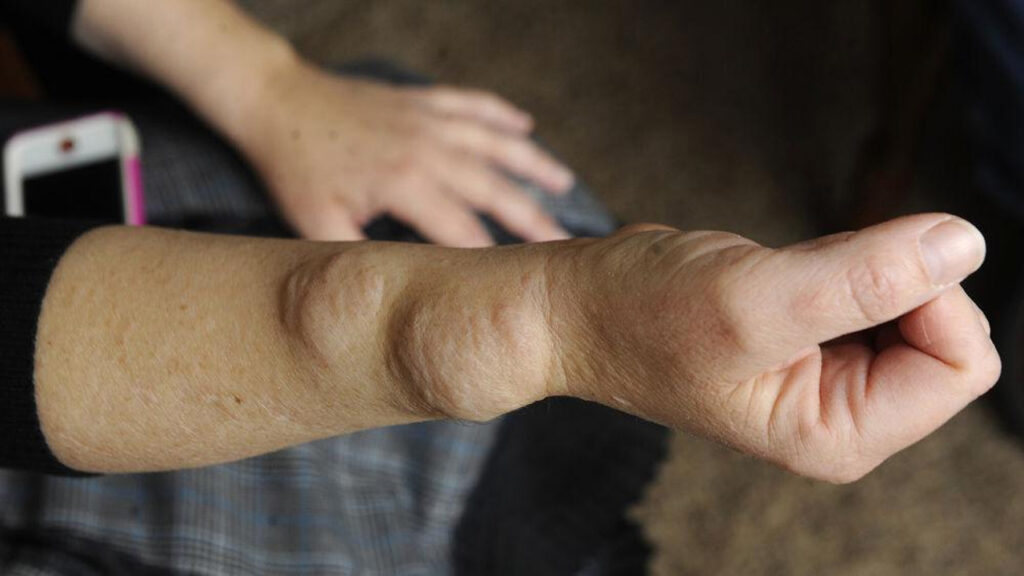
Dercum’s disease (Adiposis Dolorosa) is a rare subcutaneous adipose tissue disorder defined by the presence of multiple, painful fatty growths known as lipomas that develop beneath the skin.
Initially described in 1892 by Dr. Francis Dercum, the term “adiposis dolorosa” is derived from the Latin for painful fat, which perfectly captures the hallmark symptom of these sensitive fatty deposits.
Frequently Misunderstood
It primarily affects women during mid-adulthood and is commonly associated with patients who are overweight, although typical lipomas are painless.
Painful Lipomas: The Hallmark Symptom
Nearly every patient develops multiple lipomas, lumps of fatty tissue located just beneath the skin. These painful growths are often described as burning, aching, or tender to the touch, ranging in size from a small pea to as large as a fist.
Typical locations include the upper arms, legs, abdomen, and buttocks, often appearing symmetrically. Many patients report that even light pressure, such as tight clothing, can trigger severe pain in the affected areas.
Systemic Challenge Checklist
The clinical presentation varies significantly from patient to patient, often resembling the widespread pain of fibromyalgia:
- Chronic pain in the subcutaneous fat for at least 3 months.
- Chronic fatigue or exhausting muscle weakness.
- Unexplained weight gain resistant to caloric diets.
- Fluctuating swelling and edema in the hands or feet.
- Morning joint stiffness and headaches or migraines.
- Persistent brain fog, memory lags, and concentration loss.
- Severe sleep disturbances, insomnia, and rapid heart rate.
- Digestive issues such as painful bloating and constipation.
Ready to get an accurate diagnosis?
Dr. Schwartz and the teams in Beverly Hills and Arizona understand that lipedema treatment is not about fixing a cosmetic problem — it is about improving your quality of life.